The prompt as brief
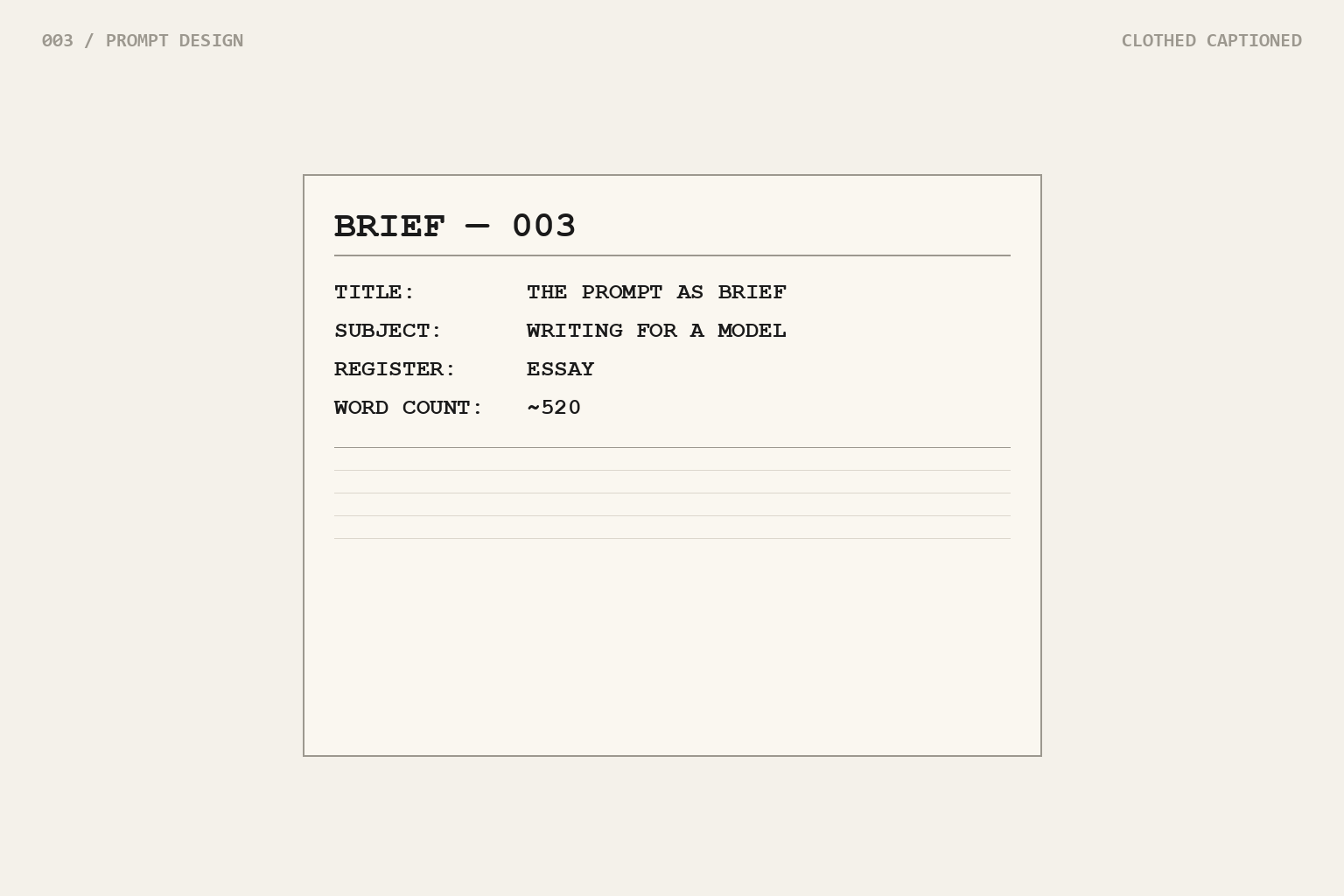
The shortest definition of a good prompt is: a creative brief that happens to be addressed to a model.
This sounds reductive, then becomes useful. A creative brief is a document a designer writes to a designer — themselves, a colleague, an agency. It names the deliverable, the reference canon, the typography, the color palette, the constraints, the things to avoid. A good one is specific enough that two designers handed the same brief produce work in the same neighborhood. A bad one says “make it pop” and gets back six unrelated mockups.
Image-generation prompts that ship usable work look exactly like that. They don’t say “modern minimalist t-shirt design with AI theme.” They say: “A 1980s European art-and-architecture magazine cover in the style of Wallpaper or Domus, ATTENTION as an ultra-bold extended geometric sans-serif masthead in pure ink black on bone, IS ALL YOU NEED in a thin condensed serif beneath, a single ochre dot tangent to a horizontal line in the central field, volume and issue numbers in monospace at the bottom, no people, no garment, square 1:1.” The model doesn’t need to be told to be creative. It needs to be told what to draw.
The four moves a prompt has to make:
Name a real reference. “Lichtenstein” gets a different output than “comic book style.” “Fraunces serif” gets a different output than “elegant font.” Specific named things have specific named visual signatures the model has actually trained on. Vague descriptors get vague averages.
Pick one canon. Pop art OR terminal screenshot OR Bauhaus OR vintage technical document — never two on the same image. Stacking design vocabularies is what produces the AI-default look that looks like everything and nothing.
Spell the words. If text is in the design, the prompt has to spell it exactly, in quotes, with case and hierarchy locked. The most common failure is the model rendering “RuntimeError” as “RuntimeRrror” — a typo that destroys an otherwise perfect image. Read every word at full size before approving.
State the negatives. The model will fill empty space if you let it. “No person, no mannequin, no garment, no frame, no watermark, no signature, no text labels, no decorative element” is not paranoid. It is the part of the brief that prevents the model from helpfully ruining the work.
A prompt this specific reads like a constraint document, which is what it is. The creative move is choosing the constraints. Once they’re set, the model is only useful insofar as it executes them.
The compliment to the model is to write a brief it can actually answer.