Two circles, one overlap
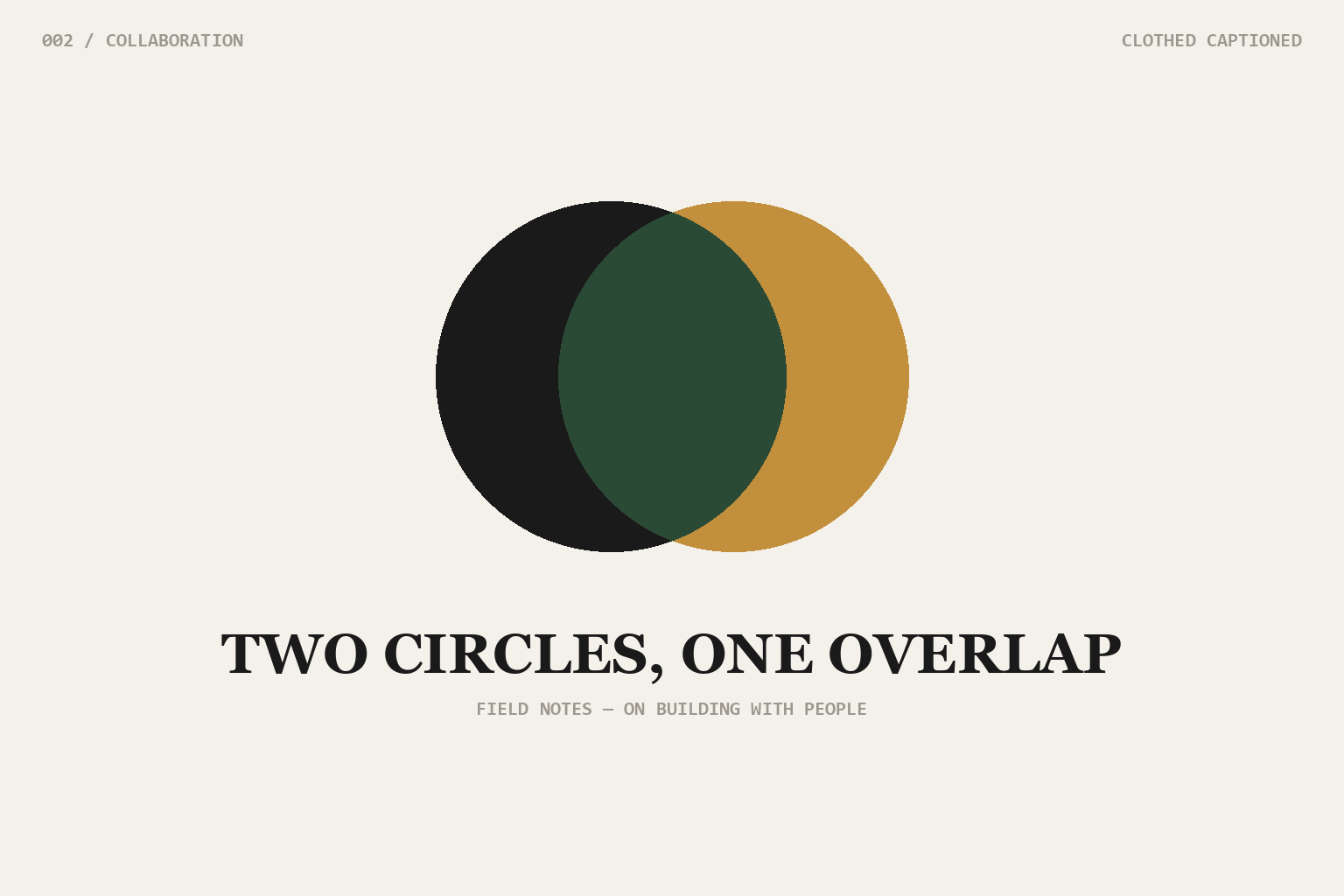
The cleanest way to think about a collaboration is this: a partner brings a circle, you bring a circle, and the work lives in the part where they overlap.
Most attempts at partnership try to do something else. They try to merge the circles, or hide one inside the other, or pretend the overlap is bigger than it is. Those efforts produce co-branded products that read as neither — the merch table at a conference, an enamel pin with two logos crammed onto it, a co-marketing email no one wanted to receive. Everyone agreed to too much, then resented the result.
The two-circle model is more honest. The partner’s circle is what they already do well — their audience, their product, their voice. Our circle is a working storefront, an apparel-side production line, an AI-led design pipeline that turns a brief into print-ready art in an afternoon, and the operator practice to run it without breaking. The overlap is exactly the work we can do together that neither of us could justify alone.
For the partner, this looks like: a hosted storefront under their domain or ours, designed in their voice but produced through our infrastructure, with checkout, fulfillment, and post-purchase email all wired in. Bring a logo, leave with a queue of made-to-order goods that ship without anyone in their org touching a fulfillment platform. Their circle stays their circle. The partnership is the overlap, not a redraw.
For us, the model lets the platform do what it’s actually for. The house catalog teaches us what the production system can carry. The collab platform extends that capacity to people who don’t want to build the same plumbing themselves. It turns the project from a brand into a working studio.
The honest thing about the two-circle model is what it can’t do. It can’t fix a partner who doesn’t already have a circle of their own. It can’t paper over a misalignment in voice — if the partner’s audience expects something the production system can’t reasonably produce, the overlap is empty no matter how generous each side is. We say no to those.
The good ones look like this: small overlap, high precision, both sides walk away with something they couldn’t have made alone. Two circles, one overlap. The merch table doesn’t enter into it.